Archive for the ‘Uncategorized’ Category

Solution for the wide nose at the level of the nostrils through Alar wedge excisions, nostril sill excisions, VY advancements, and cinching procedures.

Saturday, March 27th, 2010

Have you wondered if you need to have the skin at the sides of your nostrils reduced or what it takes to make your nose less big at the base of your nose at the level of the nostrils through rhinoplasty (Dr Young near Downtown Bellevue, WA).  If you take a look at the first picture. The green arrow shows where the alae, the tissue that covers the nostril, attaches.  If the alae flares (at the blue arrow) greater than 2 mm than a significant amount of alar flare is present and a alar wedge excision would be an appropriate procedure to narrow the base of the nose which is shown in picture 2.  Do you have a wide nasal base in the first place?  Well if your nose at your base is bigger than the distance between your eyes, you could benefit from some modification of your nasal base. As described for the Alar Wedge Excision above.  The third picture shows the Intercanthal width which is the distance between our eyes by the green arrow.  The Yellow arrow shows the interalar width.  If the Interalar width, the distance between the outsides of the alae, are larger than the intercanthal distance (or the distance between the eyes), than you could benefit aesthetically from some form of treatment to make the nose narrower in the nasal base area ( measured by the interalar width).  When you don’t have alar flaring the excessive interalar width, is due to the lateral attachment of the alae (treated by VY advancement or cinching procedures), excessive size of the nostrils (nostril sill excision), or excessive tissue in between the alae (Cinching procedure, or treating the medial crura that makes up the columnella).   First do you have excessive nostril size?  If your nostrils are horizontally oriented and are wider than the width of the columnella a nostril sill excision would be a good consideration to narrow the interalar width.  In the fourth picture, The green bracket shows the width of the columenella while the yellow bracketing shows the width of the nostrils.  The green arrow shows the nostril sill area where the resection for the nostril sill should be in the horizontal portion as seen in the fifth picture. So in the fourth picture if the green bracket of the columnella is less wide than the nostril sill denoted by the yellow bracket, the nostril sill excision could be used to narrow the nasal base. If alar flaring and excessive nostril size are not present and you still have a wide nose as shown by the interalar width, you can then use VY advancements or cinching procedures to narrow the interalar width.

Thanks for reading, Dr Young

Dr Young specializes in Facial Plastic and Reconstructive Surgery and is located in Bellevue near Seattle, Washington

Alar FlaringAlar wedge excisionInteralar Width AnalysisNostril Sill 2Nostril Sill Reduction

Rhinoplasty and the art

Friday, March 19th, 2010

Rhinoplasty (Dr Young Specializes in Facial Plastic Surgery and Rhinoplasties) is one of the hardest procedures that a facial plastic surgeon can do.  There are many steps in doing a Rhinoplasty and the steps you go through and the order is essential.  Many noses have a deviated component to it.  I usually try to make all noses straight first before doing additional work in the middle and lower part of the nose.   If you don’t make the nose straight all of the other moves that you do will further accentuate the deviation.  It starts with your septum.  You have to make sure that the septum is straight first before anything.  Sometimes this requires treating the nasal bones and shifting them to make them more in the middle as well.  Septum with all of these maneuvers the septum still doesn’t become straight. At this point, weakening the septum with 50% inferior cuts until it is allowed to come to the middle is needed.  In addition, sometimes it requires fracturing the septum higher up under the nasal bones to really weaken the septum and allow it to come into the middle.  Sometimes there are forces at the bottom of the septum near the tip that needs to be addressed including removing parts of the septum that are deviated or even shaping the spine that is at the bottom of the nose.  All of these things can be seen in the photo that is at the bottom of this blog.  Once the septum is straight then you can work on other things like the nasal tip, upper lateral cartilages to make the tip look the way you want.  I tend to do all of my rhinoplasties in the open approach and we have a picture of how that heals on our website.  This allows me to more accurately control things in the nose cutting down drastically my revision rate.  I also employ non destructive techniques for the best controlled long term solid results.  I never morselize, or weaken the cartilages to get results.  There is too much variables in healing that can lead to a bad result.  I hardly cut the cartilages and leave them to heal. They are always reconstituted and always done away from the tip area.  Sometimes in thin skin, I will crush cartilage to cover sharp edges on the tip areas or other areas to soften the results.  But the foundation is never crushed or morselized.  My order of rhinoplasty proceeds like this: markings, injections, open approach, address the nasal bridge first, if there is a deviation, treat the nasal bones through osteotomies to make the septum straight,  septal harvesting for grafts preserving 1.5cm of struts for ultimate support, septal restructuring to make sure that it is straight, further work on the nasal bridge, then proceeding to reconstituting the upper lateral cartilages to the septum,  then I start on the tip work including trimming the lateral crural cartilages, tip suturing (columnellar strut, medial crural sutures, transdomal sutures to narrow the tip domes, interdomal sutures to make the whole tip smaller, setting the tip’s projection, controlling the rotation through a tip rotation suture), then closure which includes closing the dead space.  Below is a picture of the anatomy of the nose.  The middle crura is in between the lateral and medial crura.  The middle crura cartilage and the junction with the lateral crura creates the tip highlight and the tip is mainly made up of the middle crura with the lateral and medial contributing to how the middle crura is presented on the nose.  The lateral process of the septal nasal cartilages are otherwise known as the upper lateral cartilages.  The lateral, middle and medial crura make up the lower lateral cartilages.

I hope that was interesting for you!

Thanks for reading, Dr Young

Dr Young specializes in Facial Cosmetic and Reconstructive Surgery and is located in Bellevue near Seattle, WashingtonNasal bones and anatomy

How soon can I fly after a blepharoplasty procedure?

Wednesday, February 10th, 2010

After Blepharoplasty and other significant facial surgery, staying near your doctor for the first weeks is important.  The most important periods when bleeding can occur is usually the first 24 hours where most events (greater than90%) occur.  The second point is 6-7 days later when the clots start to dissolve and there is a period when the blood vessels are unstable.  Sudden bleeding can lead to significant pressure on the eye that might need to be addressed immediately.  Sometimes this pressure can put your vision at risk.  I usually suggest not flying for at least 2 weeks from the procedure.

Thanks for reading, Dr Young

Dr Young specializes in Facial Plastic and Reconstructive Surgery and is located in Bellevue near Seattle, Washington

Epicanthal folds can keep an Asian Blepharoplasty result from realizing its full potential

Tuesday, February 9th, 2010

Often times, when you do an Asian Eyelift (Aesthetic Facial Plastic Surgery in Bellevue, WA) you can create tension at the middle part of the eye where the epicanthal fold is located.  When the crease is made higher than lower, the tension that the higher fold creates can place tension on the epicanthal fold and lead to what is commonly referred to as the round eye deformity.  The appearance is an eye that looks round because it has increased its dimension in the superior and inferior direction but has remained the same in the horizontal dimension.  In this case, an epicanthal fold can relieve this tension and create a more pleasing appearance to the eye by reshaping the epicanthal fold. There are four types of epicanthal folds.  Type on is where there is no extra fold of skin that covers the fleshy part of the middle part of the eye called the lacrimal lake.  When the epicanthal fold covers the top part of the fold and partially covers the lacrimal lake like the picture below a type 2 epicanthal fold exists.  When the fold totally covers the fold a type 3 epicanthal fold is present.  When the fold is reversed and is mainly originating from the lower eyelid, a type 4 epicanthal fold is diagnosed.  Below shows a very common way to reshape the epicanthal fold.  Point B is where the epicanthal fold transitions into the lower eyelid. Point A is the medial most point of the lacrimal lake. There is another point on the other side of the epicanthal fold that is called point D coinciding with the surface representation that is Point A.  Point C is the extension of the marking from Point A that meets with the double eyelid crease markings that comes from Point E where the epicanthal fold meets the upper eyelid transition.  Lines AB, BD, and AC are all equal.  Simply put, the triangle EAC is excised and after cutting DBA, the flap DBA is moved to ECA used to be.  The lines BD and AB are sutured together.  Here is video on Asian Blepharoplasty and Medial epicanthoplasty.

Thanks for reading, Dr Young

Dr Young specializes in Facial Plastic and Reconstructive Surgery and is located in Bellevue near Seattle, Washington

park z epicanthoplasty

Pretarsal show and Epicanthal fold are important terms when you do Asian Blepharoplasty

Tuesday, February 9th, 2010

I wanted to talk about the various terms that people are using when they consider Asian Blepharoplasty (Seattle’s Dr Young).  One is Pretarsal show. Essentially this is the height of skin that is exposed under the crease when the eye is opened.  See the picture below.  You measure or assess this when the patient’s eye is open and the height that is measured from the crease to the eyelid margin where the eyelash is located is the height of the pretarsal show when the eyes are open.  This is different from where the crease actually begins which could be, and usually is, much higher underneath the fold of skin that folds over where the crease begins.  When you determine where you put the crease, the amount of skin you take will affect the pretarsal show.  I usually use a metal pointer to stimulate where I will make the crease and have the patient open up there eyes.  At that point, I will ask the patient if the pretarsal show is high enough.  But I usually ask whether the “crease is high enough”. Usually the crease is set between 6 and 8 mm for a small fold.  If the pretarsal show is not high enough after placing the metal pointer at 8 mm I usually then think of taking more skin.  Then depending on how high the patient wants I usually estimate how much higher and then I multiply that by two which determines how much skin I take.

The other question I ask patients is whether they want they crease to end medially with an inside or outside fold. The picture below shows an inside fold.  An outside fold would be end closer to the nose and closer than the fold of skin where the epicanthal fold is located.  The epicanthal fold is just the extra skin that covers the fleshy part of the medial part of the eye (which is called the lacrimal lake).

To maintain you ethnicity, I usually like to make the pretarsal show no higher than 3mm and the medial part of the crease is usually an inside fold.

The epicanthal fold is another area that you can treat.  Through a different techinque you can make the epicanthal fold more open by transposing the tissue of the epicanthus more medially.  This can open up the eye and improve the results of an Asian Blepharoplasty.  I use Dr Park’s Z epicanthoplasty for most of my epicanthoplasty procedures. You can read my other blog on Dr Park’s Z epicanthoplasty that I like to do.  Here is video on Asian Blepharoplasty and Medial epicanthoplasty.

Thanks for reading, Dr Young

Dr Young specializes in Facial Plastic and Reconstructive Surgery and is located in Bellevue near Seattle, Washington

eye anatomy front view

Orbicularis to Levator Fixation can lead to longer lasting results and more definitive crease formation with Asian Double Eyelid Blepharoplasty.

Tuesday, February 9th, 2010

There are many options with Asian Double Eyelid Crease Formation (Dr Young Seattle) including whether to use incisions or not, how to fixate the crease, how high the incision should be, whether an inside the fold or outside the fold crease is desired, if an epicanthoplasty should be done.  This particular blog will focus on how we do the internal fixation.  Most surgeons, greater than 90%, use the external fixation sutures to make the crease.  Essentially what we do is first make the incision and then we have to make our way down to the orbital septum.  It is essential to be very careful in doing this because you don’t want to start too low and enter the orbital septum below where the orbital septum and levator come together.  If this is done you could injure the levator and cause ptosis which is when your eyelid is lower in relation to the iris and you essentially look like you aren’t opening your eyes as big as before.    After we reach the orbital septum we then enter into the “post” septal space and elevate the post septal fat and find the levator. Traditionally at this point  the skin is then tacked to the levator with sutures and this is what causes the crease to form.  These sutures are then taken out 7 days later.  Usually this is enough to cause enough scarring to last a long time.  Another way of doing this is to tack the orbicularis muscle as shown in the photo below to the levator with orbicularis-levator fixation sutures.  These are internal fixation sutures that stay in there permanently.  In addition to these sutures, I also do the external sutures for extra assurance that the fold will stay for a very long time if not indefinitely.  The internal sutures have the benefit of acting more like the natural action that the levator has on the skin that is in front of the tarsus.  Here is video on Asian Blepharoplasty and Medial epicanthoplasty.

Thanks for reading, Dr Young

Dr Young specializes in Facial Plastic and Reconstructive Surgery and is located in Bellevue near Seattle, Washington

Upper eyelid anatomy

Surgery or volumizing. What should I do?

Thursday, February 4th, 2010

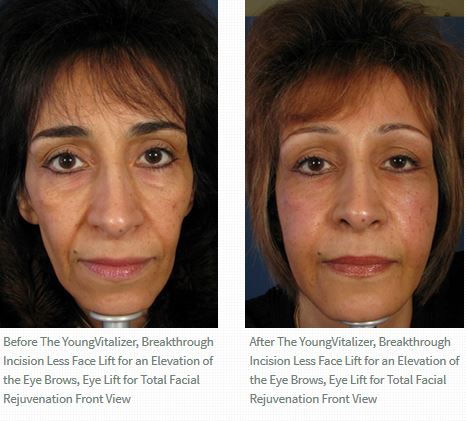
I think ultimately when you talk about facial rejuvenation, at one point you will face this question of whether to undergo surgery to remove extra skin and lift or the other choice of filling up the space to volumize the extra skin and the space around it.  Take for example the eyes.  Traditionally plastic surgery and its surgeons typically took away skin and fat.  That usually improved the situation but often times, in many cases, the person didn’t look younger necessarily.  Aging is predominately a process of losing volume in the face and around the eys and the way to reverse that is to replace this volume.  Here is a pictures of what improvements you can get after volumizing around the eyes (Dr Young’s Website Seattle, Washington): (see the person at the very bottom of the page).  I usually say that aging is a process that is analogous of a grape changing into a raisin.  Traditionally plastic surgery would make that raisin into a smaller raisin and not like the younger grape that it once was.  Volumizing returns the person’s face back into the grape it once was.

So when do you opt for the traditional reductive type of procedures where things are removed such as when you do an eyelift, browlift, facelift and the like? Well it depends on how you looked like when you were young.  If you thought your face was larger than you liked when you were young then some reduction may be necessary. I have a lot of Asian women who used to have much larger faces which they didn’t like.  They like there shape now that it is smaller but they still look aged.  I think some reductive type of procedures for this particular situation may be more necessary.    Reductive type of surgeries are also more indicated when the person gains a lot of weight and changes the face shape from what it was when that person was younger.  In this case as well, reductive type of surgeries would be more beneficial before volumizing.  Ultimately, whatever the face is looking like right now and what changes it needs to reach the ideal is what you would be most beneficial in doing.  I use my theory to find that ideal for people.

Thanks for reading, Dr Young

Dr Young specializes in Facial Cosmetic and Reconstructive Surgery and is located in Bellevue near Seattle, Washington

Earlobe reduction can markedly improve the aging looking earlobes.

Sunday, January 17th, 2010

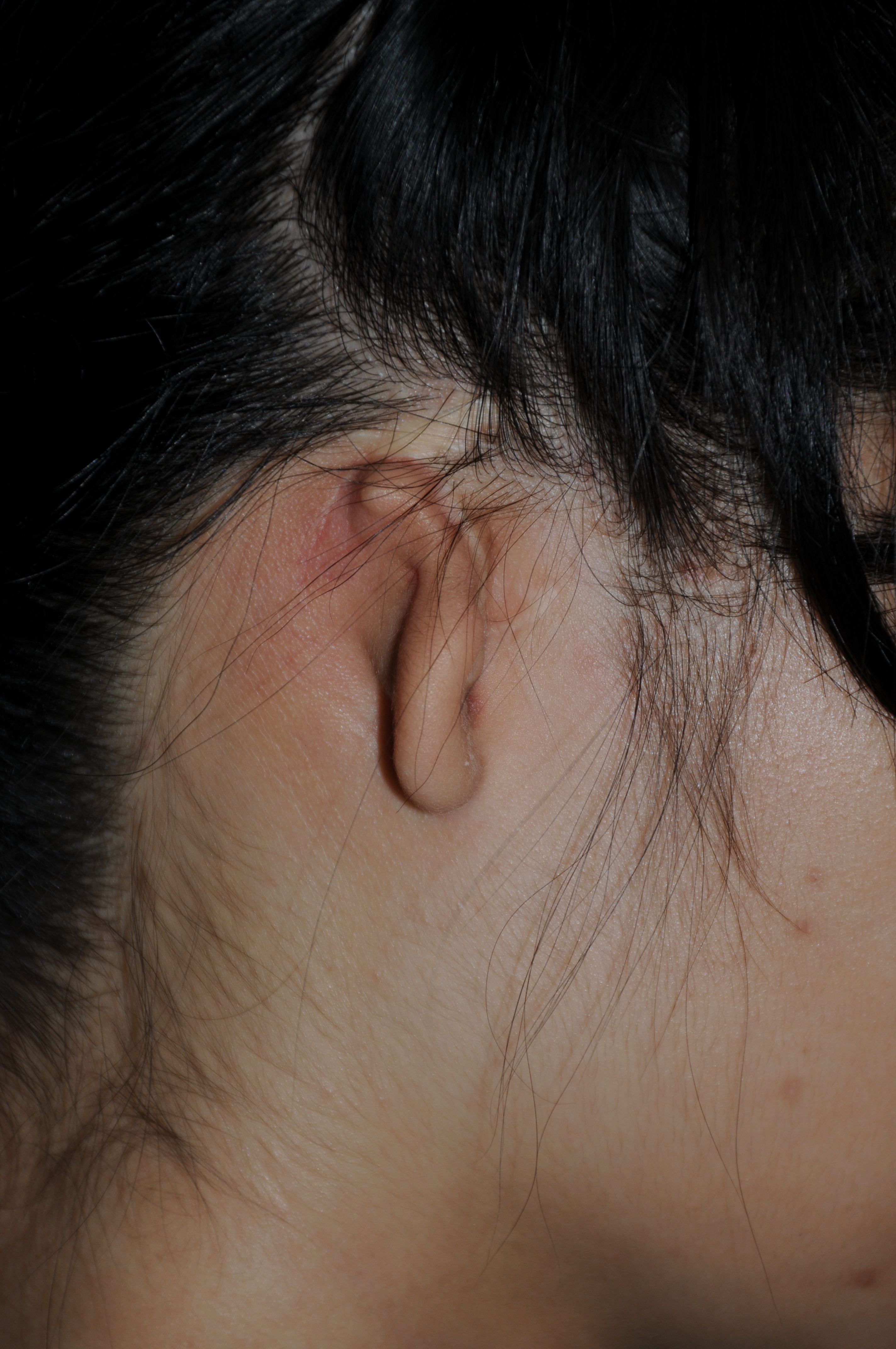
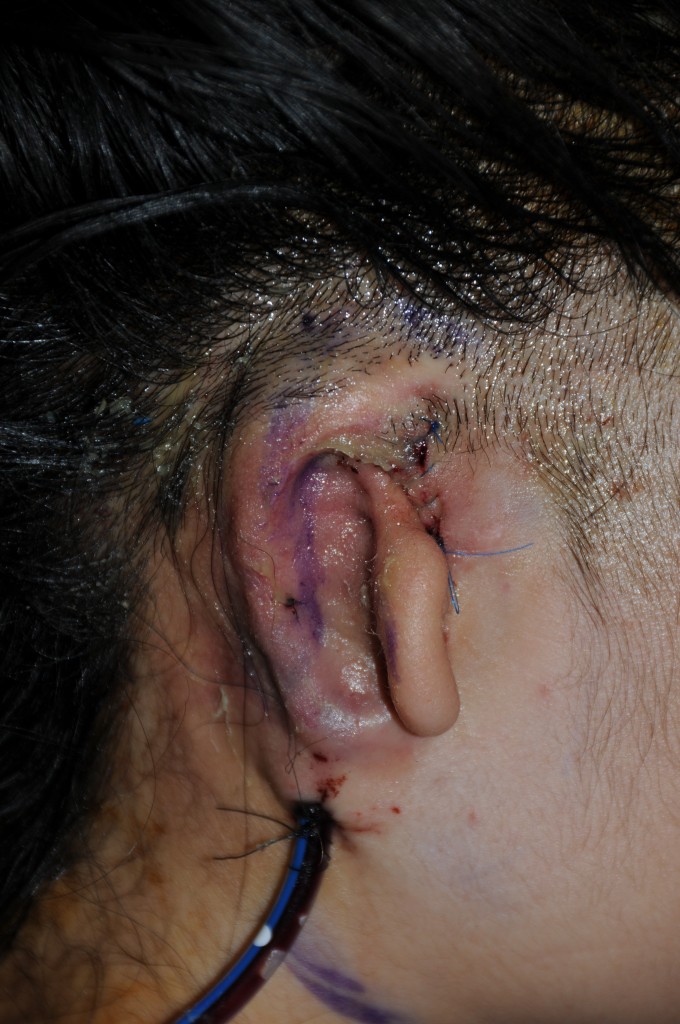
Otoplasty (ear shaping, ear pinning, ear reshaping, ear plastic surgery, ear cosmetic surgery, earplasty) is the art and surgical procedure of shaping the ears to a desired shape. As one ages, your earlobe can lose volume and also ligaments within the earlobe can be stretched to ultmately give you a larger earlobe, with creases that can make your ears look aged.  Also, the enlarged earlobe can be distracting in and of itself from an aesthetic standpoint. Otoplasty can be done on the enlarged earlobe to acheive a shape and size that is more desirable in appearance.

Thanks for reading, Dr Young

Dr Young specializes in Facial Cosmetic and Reconstructive Surgery and is located in Bellevue near Seattle, Washington

My background and how I came to do what I do

Saturday, January 9th, 2010

One moment of my life that made a huge impact was the loss of my mother.  This occured when I was an undergraduate at the University of Washington.  This was obviously the saddest moment of my life.  I think that experience made me really appreciate life.  When I started undergraduate school, I began as premed.  I always wanted to be a doctor. My father was a real estate developer and that began to influence me.  During my first year, I switched majors to start to concentrate in Business.  I was accepted into the School of Business and started going to classes.  After the passing of my mother, I had a rejuvenated desire to return to medicine and did a total switch into that route.  That eventually led me to Tulane medical school in New Orleans, Louisiana.  I choose this school because it was located in a city that was totally different from Seattle, Washington.  It was a complete culture shock there but an amazing experience.  While in medical school, I was fascinated by the anatomy of the Head and Neck region.  This influenced my concentration of my studies toward Otolaryngology, which is the specialty of Head and Neck Surgery, commonly known as ENT, or Ear Nose and Throat.  I was then accepted into the residency program at University of Southern California, which is one of the top schools in the country. During residency, I had a broad range of experience in this field. I originally thought that I would go into the treatment of Head and Neck Cancer.  While learning this particular subspecialty, I was introduced to the reconstructive aspects of this specialized field.  Coupled with the very difficult role of diagnosing and being the bearer of bad news for people with cancer, this interest in the reconstructive aspect motivated me to learn more about the subspecialty of Facial Plastic and Reconstructive Surgery.  As I learned more about the field of Facial Plastics one element of this field began to fascinate me more and more.  One thing I noticed while in Los Angeles were the less than optimal results from plastic surgery that was occurring for many Hollywood stars.  I thought that if the most rich and famous people were getting these results that something must be missing in this field.  This lead me to gradually concentrate my interests into the field of beauty and specifically the ideas of beauty. The question I wanted to answer was ” what makes a face beautiful’?  Surprisingly, I found that no one really knew.  Our ideas of beauty were based on what is known as the neo classical canons.  These are rules of beauty that were brought down through the ages but originated during greek times. The were termed “neo” because they were revised during the renaissance and by Leonardo Da Vinci in the 1400′s.  I was shocked to find out that our rules of beauty had not changed much since the 1400′s.  If you read my paper you can find out about what some of the rules were at http://www.drphilipyoung.com/pdf/circles_of_prominence.pdf.  But essentially they are dogmatic rules based on external landmarks that I found occupied very little time when a viewer looks at a face when it analyzes it.  This question lead me to this journey of finding what beauty is and how to attain it for my patients.  During residency in Head and Neck Surgery, I applied for a Facial Plastics and Reconstructive Fellowship.  I was chosen among many candidates to train at Shreveport, Lousiana under the famous Dr Frederick Stucker, one of the grand masters in this field.

Thanks for reading, Dr Young

Dr Young specializes in Facial Cosmetic and Reconstructive Surgery and is located in Bellevue near Seattle, Washington

What are the long term side effects of Sculptra? Is it a smart choice? Who are the best candidates?

Wednesday, December 30th, 2009

Sculptra is actually the powder form of a suture, Vicryl, that has been used in surgery for many years without significant problems. The body absorbs the powder and eventually turns it into carbon dioxide and water. The benefit of Sculptra is that during this inflammation to degrade the Sculptra collagen formation is being carried out by the body in a scar like reaction. It is this collagen that creates the new volume.  With this inflammation there is the risk of infection.  However the benefit of having the inflammation to create the collagen in a scar form is paradoxically what can lead to the infection.  If you didn’t have this inflammation you wouldn’t have as much collagen formation.

In my opinion, Sculptra is most beneficial for the person who does not have a lot of fat in the rest of the body to undergo fat injections and would like some more volume in the face.  It is also useful in the person who has only a little fat to offer for fat injections.  In this particular situation I would use sculptra in the areas that can tolerate it more such as the cheeks, mouth area, temples, forehead and jawline areas and reserve fat injections for the areas closer to the lips and around the eyes.  It is also good to use Sculptra for people who don’t want the invasiveness of fat injections where you have the need to harvest the fat from somewhere else. Sculptra, in general, is less of a process than fat injections.  But with the negatives that come with Sculptra, there is a lot of positives for people in these situations above.

From a long term standpoint, once the Sculptra is dissolved there should not be long terms issues. If a person somehow does not degrade the Sculptra effectively there could be infections but there are ways to treat these issues without a lot of problems.  Silicone injections and Artecoll injections present more long term issues in my opinion.

Hope that helps!

Thanks for reading, Dr Young

Dr Young specializes in Facial Cosmetic and Reconstructive Surgery and is located in Bellevue near Seattle, Washington