Archive for the ‘Facial Implants’ Category

When can you time Chin Implant Surgery with Braces?

Friday, September 4th, 2009

Chin implant surgery (or chin augmentation / chin enhancement / chin reduction / jaw implant surgery / chin silicone implant surgery / chin shaping / chin reshaping) occurs at the bottom of your chin and jaw area which are not in the same vicinity as your teeth and braces.  The only concern that I would have is regarding the hygiene in your oral cavity.  With braces, you are more likely to have residue in your braces and around your teeth and the bacteria load is likely to be higher.  Because of this I would rather do the approach through the bottom of your chin where the incision can hide really well.  Otherwise, I think you can do it with having braces.  Of course, I would wait until you are adjusted to any period where tightening of the braces occur for your comfort.

thanks for reading Dr Young

Dr Young specializes in Facial Cosmetic and Reconstructive Surgery and is located in Bellevue near Seattle, Washington

Can fat injections be permanent? What are some options.

Monday, August 31st, 2009

Fat injections (fat transfer / fat grafting / fat augmentation) can be “permanent”. One thing to realize is that fat injections and anything in life aren’t necessarily permanent and forever.  Fat injection results can last many years if done right.  Just like the fat that you had when you were younger, they eventually went away after a while as you aged.  This same process will eventually happen to the fat that you have injected.  Over many years, the fat will get metabolized as you age but the results may last for 10 years or more.  Another option of volumizing is through facial implants.  Silicone is the most common implant that people place within the face and these implants can last essentially forever.  Facial implants (silicone implants / cheek implants / jaw implants / facial implantation / chin implants) are more of a permanent option but the drawbacks are having a foreign material placed within your face and it does require more incisions and likely recovery time than fat injections.  If you can handle the idea of putting something foreign into your face this is a great option.  Silicone implants have been placed into thousands of patients around the world and has an excellent track record for safety.  You can see more on fat injections on my website and youtube account.

I refined an amazing volumizing procedure called “the YoungLift”. This is an innovative technique that volumizes your face to bring out the younger and natural you without looking like you had something done. This is not a facelift and requires no incisions. Only pinpoint puncture sites are used and these heal imperceptibly. The YoungLift can be done without general anesthesia and without drains, and large bandages. You also have a lot less downtime and discomfort compared with traditional facelift procedures. I employ the very best techniques from around the world into one volumizing procedure and I use my internationally acclaimed understanding of facial beauty to create the youthful volume you once had.

thanks for reading Dr Young

Dr Young specializes in Facial Cosmetic and Reconstructive Surgery and is located in Bellevue near Seattle, Washington

How is a chin implant surgery done

Saturday, August 8th, 2009

Chin implants (or chin augmentation / chin plastic surgery / chin job / chin cosmetic surgery / chin enhancement surgery) are usually done through two approaches.  You can make an incision under your chin or in your mouth to place the implant.  The most common way to do it is through an incision under the chin.  This usually leaves a barely visible scar.  The incision is around 2-3 cm in length and the implant is place on your own chin bone and is fixed so it doesn’t move.  Over time the chin implant will feel like your own bone and like its your natural jaw.  You can also place it through your mouth but this usually has more associated issues with this approach.  First you have to put it past all of the bacteria that usually resides within your mouth and this can lead to increased risk of infection. Also through this approach you usually alter the way the chin muscle sits and this can cause some chin drooping because the muscle is not adequately attached to bone through this approach.  Also with through the mouth, the nerves that brings sensation to your chin and lower lips can be more affected and lead to more chances of numbness.

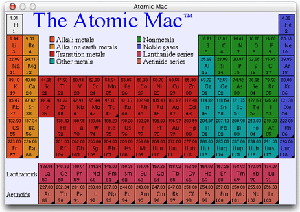
The usual implant that is placed is silicone which is really compatible to your tissues.  Carbon is right above Silicone (Si) on the atomic chart.  Because they are very similar the body thinks of it like carbon and finds it less intrusive and doesn’t mount a large immune response to it.  Hence silicone implants are highly adaptable to the human body and there is very little risk of cancer, rejection, infection and other problems that you might get with goretex, med por, and other implants. Silicone implants that are solid have been placed in thousands of people with no problems over many years and decades!

Thanks for reading, Dr Young

Dr Young specializes in Facial Cosmetic and Reconstructive Surgery and is located in Bellevue near Seattle, Washington
60858-atomic_mac

What are the options for sunken cheeks besides temporary dermal fillers?

Wednesday, August 5th, 2009

This is a questions I answered for someone that was wondering what option there were for sunken cheeks besides temporary dermal fillers. Fat injections or silicone implants can give you the long term volume you desire in the cheek.

Sunken cheeks is a natural aging process.  When you age you lose fat in your cheeks and this can lead to your tissues descending, wrinkles developing, folds developing, lower eyelid fat protruding, eyelid bags, etc.  Dermal fillers like restylane, juvederm, radiesse, perlane, are temporary and last from 6 months to a year or more.  Of these fillers radiesse is a bone product made up of calcium hydroxyapatite while the others are made up of hyuloronic acid.  There are more permanent fillers like silicone injections, and artefill.  The problem with permanent fillers is that they have the potential to cause infections, scarring and granulomas (balls of chronic infection) that can present years later after you think everything is okay.

Other more permanent options for sunken cheeks include fat injections and silicone implants.  Silicone is very compatible to place in the cheeks.  The silicone atom is one step below carbon on the atomic chart and hence makes it really compatible.  The infection rate with silicone is very low and its use has a long history of safety.  Silicone implants can be placed within the cheek to give a person a more permanent volumizing and lift up sunken cheeks.

Fat injections are another way of volumizing the cheek. Perrmanency depends on whether the fat survives.  This depends on many factors: technique, health of the patient, care of the patient after the procedure, etc.  If fat lasts for more than 6 months to a year, it will likely survive for many years sometimes 10-15 years or longer.

I refined an amazing volumizing procedure called “the YoungLift”. This is an innovative technique that volumizes your face to bring out the younger and natural you without looking like you had something done. This is not a facelift and requires no incisions. Only pinpoint puncture sites are used and these heal imperceptibly. The YoungLift can be done without general anesthesia and without drains, and large bandages. You also have a lot less downtime and discomfort compared with traditional facelift procedures. I employ the very best techniques from around the world into one volumizing procedure and I use my internationally acclaimed understanding of facial beauty to create the youthful volume you once had.

Dr Young is located in Bellevue near Seattle, Washington

When should I have the anchor sutures taken out after a facelift and chin lift?

Friday, July 10th, 2009

It really depends on the doctor after your facelift and chin implant. I would go by what he is used and find works for him.  I usually take out anchor sutures one month later.  Not every doctor has anchor sutures placed and will just have you come back 7 days later approximately to have the sutures removed.  Anchor sutures are placed to help with the healing and are usually few in number. Basically, the longer you have the sutures in the greater the chance for scarring and train tracking.  Train tracking is essentially the appearance of train tracks due to the sutures leaving marks where they were.

Dr Young is located in Bellevue near Seattle, Washington

How do you build up the cheek?

Monday, July 6th, 2009

Building up the cheek can be done through multiple different means. This can be done with various fillers including restylane, juverderm, more radiesse, fat injections, or facial implants.  Either of these options have benefits and drawbacks.  The fillers are temporary and you will need reaugmentation in 6 months to a year.  Facial implants will last essentially forever but need to be done in the exact way and augment your cheek in the best way.  When you place cheek implants into the cheek area, sometimes the cheek can be fixed on the cheek bone with metal screws and if there is less than ideal augmentation more or less then you can tailor the augmentation through different means.  If you have too much augmentation, you can tailor the cheek implant with burrs if the cheek implant is solidly fixed with the screw.  If it is not big enough you can always place a bigger implant or  fix more silicone onto the existing implant with sutures. The key with silicone or other implants is to have the implant fixed so its stable, not moving and not collecting fluid between it and the bone.  These are things that can prevent infection and rejection. Silicone is probably the safest and most stable and non reactive implant that you can place.  Other implants create more inflammation and have a higher incidence of rejection and infection.

Fat injections are another way of building up the cheek.  The survival of fat is variable but if the fat survives after the first 6 months to a year the fat will likely survive for years.

I refined an amazing volumizing procedure called “the YoungLift”.  This is an innovative technique that volumizes your face to bring out the younger and natural you without looking like you had something done.  This is not a facelift and requires no incisions.  Only pinpoint puncture sites are used and these heal imperceptibly.  The YoungLift can be done without general anesthesia and without drains, and large bandages.  You also have a lot less downtime and discomfort compared with traditional facelift procedures.  Dr Young employs the very best techniques from around the world into one volumizing procedure and he uses his internationally acclaimed understanding of facial beauty to create the youthful volume you once had. The YoungLift techniques can help with filling up the lips as well.  You can great results with fat injections in the lips.

Dr Young is located in Bellevue near Seattle, Washington

Looking for a non surgical way to make the double chin go away or improve it

Friday, July 3rd, 2009

There are many options such as losing weight. This can reduce the fatty deposits in your neck. However, depending on someone’s age, some of the double chin can be due to the muscles relaxing.

You have a neck muscle called the platysma that covers your neck from your chest to your face. This muscle during youth is tightly adherent to the underlying neck structures. When you age, the muscle eventually comes away from the neck’s deeper structures, contributing to the neck laxity and double chin appearance.

The main way to improve this is to do a neck lift along with a lower facelift. Liposuction is a very minimally invasive technique to slim down the neck and tighten the skin as well. But sometimes, the results you get with liposuction is limited, and more advanced techniques are needed to make your neck more shapely.

Augmentation of your chin can help create a greater disparity between your face, chin and neck region. Chin implants can help improve the angles of your chin with your neck. Other options that are less invasive include volumizing your lower face. This can have a tremendous impact on pulling the loose tissues up towards the area under your chin and also create more of a covering effect for the contents below your jawline.

The other way of improving this laxity is to use lasers to tighten the skin.  Active and Deep fx combined can have significant tightening effects.  This can be done without making incisions and with lower downtime compared with traditional co2 laser resurfacing procedures.

Dr Young is located in Bellevue near Seattle, Washington

Fat grafting or facial implants?

Saturday, June 27th, 2009

Some people are afraid of having implants and this an important thing to consider. I usually use implants to volumize the face when a person does not have a lot of fat to use, for example in women that are physically fit and have little body fat or if they don’t want to go through the harvesting of the fat that requires liposuction in another area of the body.

After implantation, you can then use the little fat that the person has to augment the implant. I usually do this in two phases with the implant first and then fat grafting at a later date. You also have to consider that fat and implants have different characteristics as well.

Implants require more incisions and usually are placed through the mouth. Fat transfer requires small holes instead of long incisions. Implants can also help in that fat transfering is needed less and cuts down on the need for more extensive fat harvesting.

I refined an amazing volumizing procedure called “the YoungLift”.  This is an innovative technique that volumizes your face to bring out the younger and natural you without looking like you had something done.  This is not a facelift and requires no incisions.  Only pinpoint puncture sites are used and these heal imperceptibly.  The YoungLift can be done without general anesthesia and without drains, and large bandages.  You also have a lot less downtime and discomfort compared with traditional facelift procedures.  Dr Young employs the very best techniques from around the world into one volumizing procedure and he uses his internationally acclaimed understanding of facial beauty to create the youthful volume you once had.

Dr Young is located in Bellevue near Seattle, Washington

Volumizing the face through facial implants or fat transfer

Wednesday, June 24th, 2009

Some people are afraid of having implants and this an important thing to consider. I usually use implants to volumize the face when a person does not have a lot of fat to use, for example in women that are physically fit and have little body fat.

After implantation, you can then use the little fat that the person has to augment the implant. I usually do this in two phases with the implant first and then fat grafting at a later date. You also have to consider that fat and implants have different characteristics as well.

Implants require more incisions and usually are placed through the mouth. Fat transfer requires small holes instead of long incisions. Implants can also help in that fat transfering is needed less and cuts down on the need for more extensive fat harvesting.

Things to think about regarding Facial Implants

Wednesday, June 24th, 2009

Facial implants can markedly change the way you look in a good and bad way. It all depends on what you need and what your current aesthetics are. You need to have a surgeon that has an understanding of facial aesthetics.

Depending on what you look like, you can place chin, cheek, jaw and periorbital implants that can really improve your appearance. Silicone implants are the most compatible but have less integration than some other more porous implants like medpor and goretex. I prefer Silicone because of its compatibility but there are many other implants that are very compatible and have proven records in terms of acceptance by your body. Methylmetacrylate has a long history of implantation with very low percentage of problems. Medpor, porous polyethylene, has a low risk but in terms of rejection appears higher than silicone.

To me silicone, is the best implant available due to its low risk of rejection by the body and that’s what I use in the nose, jaw, chin and for implants around the eye, temple, and forehead. Facial implants are great way to augment your facial shape for the better.