Archive for the ‘Otoplasty / Ear Reshaping / Ear Shaping’ Category

Philip Young MD discusses otoplasty / ear cosmetic surgery cost and ways to evaluate the pricing

Monday, August 2nd, 2010

A frequent question that people have is how much does otoplasty / ear plastic surgery / ear shaping surgery / ear reshaping surgery cost.  There are some resources for the average cost of otoplasty that range from 2500-3000 for the surgeons fee.  That doesn’t include the costs for the facility and for the anesthesia and anesthesiologist.  The fee for the facility ranges from 500-2000.  The fee for the anesthesiologist ranges from 200-1000.  So the range for an otoplasty can be from 3200-6000.  We have a surgical facility near us and they charge 650 for the first hour for the anesthesiologist and each additional hour is 300 for each additional hour.  The facility is 1000 for the first hour and each additional hour is 500.   Sometimes, otoplasty is done for just one ear.  The costs for this can be lower. Usually surgeons reduce the price a little bit for otoplasty for 2 ears instead of one.  So you will usually pay a premium for the one ear.

It is good to find out what the average price for otoplasty is for your area.  You can do this by going to multiple consultations.  Sometimes you get what you pay for, as they say.  Somewhere in the average might be a good idea, at least do consider someone that is extraordinarily above the others unless there is compelling evidence that you think that person will do the job that justifies the pricing you receive.

Thanks for reading, Dr Young

Dr Young specializes in Facial Plastic and Reconstructive Surgery and is located in Bellevue near Seattle, Washington

Dr Young talks otoplasty: Specifically the incisionless technique who it relates to age (Located in Bellevue, Issaquah, Seattle Washington).

Friday, July 30th, 2010

There are many ways to do this incisionless otoplasty.  But this can mean many different things.  When children are very young like less than 3 months old, you can mold the ear to permanently take on a new shape by just external molds. We have a system that does this.  But when you are a teen you need more involved approaches.  There are ways to do the incisionless technique but these methods are often less reliable than traditional techniques.  I often do incisionless otoplasty / ear reshaping through small punctures in the front of the ear to shape the ear.  These are better when the main cause of your ear appearance is due to a lack of fold in the periphery of the ear.  If the reason for your concern is due to the ear being too prominent because the base of the ear is too developed, the incisionless technique is even more less reliable.  The traditional technique can be done under local or iv sedation and is essentially a minimally invasive procedure and done through incisions in the back of the ear that usually heals imperceptibly in the back of the ear and as a whole.

Thanks for reading, Dr Young

Dr Young specializes in Facial Plastic and Reconstructive Surgery and is located in Bellevue near Seattle, Washington

Dr Young talks about Pixie Ear Deformity Correction (Seattle, Washington)

Friday, July 30th, 2010

A pixie ear deformity is when the earlobe gets pulled down inferiorly so that it becomes elongated.  It often occurs after a facelift procedure when there is too much skin taken and not enough fixation of the muscle to hold up the lift.  Some people are naturally like this.  There are several ways to improve this situation.  Oftentime it entails elevating the earlobe so that it is not as pulled down.  But it can entail closing the area below the new earlobe where the used to be.  Sometimes you can avoid this closure area by relifting the face and pulling the earlobe back by moving the skin backwards.

You don’t necessarily have to correct the other ear if you are satisfied with the way it looks.  But many things can be done to change the appearance of your ears if so desired.  These are all questions that you can ask your particular physician when you go into your consult.  I try to answer as many questions as my clients can think of during the consultation. I also offer my email for them to write me more questions if they have any given that people usually start wondering about more things after they leave.  I also check my email multiple times in a day so I can be attentive as possible to their questions and concerns.

Thanks for reading, Dr Young

Dr Young specializes in Facial Plastic and Reconstructive Surgery and is located in Bellevue near Seattle, Washington

Setting back the Ear during Ear Pinning / Otoplasty is a very important part of the procedure

Saturday, March 27th, 2010

A conchal setback is when the Concha is sewn back to the tissues behind the ear to make the ear more pinned back during an otoplasty or cosmetic ear reshaping procedure (Dr Young is a Facial Plastic Surgeon in Bellevue Washington). Many times a prominent ear is due to the conchal bowl being to developed and strong.  The tissues behind the ear are reduced and then the ear is sewn backward to make the ear appear smaller.  Take a look at the picture below to see what I mean by the concha.  I have found over the years watching many famous surgeons who do ear reconstruction, otoplasty like Dr Reinish and Dennis Crockett in Los Angeles when I was training in LA and Dr Burt Brent in Woodside California that there are a lot of different techniques out there.  I have found that just removing the tissue behind the ear is not sufficient a lot of times to make the ears more pinned back.  I have found that shaving the concha cartilage down incrementally is essential to allowing the ear to more easily and more permanently be pinned back towards the head.    What I learned is that you need to be very incremental in how much you shave.  There should be a little tension in the cartilage when you pin in back otherwise the results can be less predictable.   As show in the picture below, I use a scalpel to take down the cartilage a little at a time and I usually reassess after every short session of debulking the conchal cartilage.  The scalpel is shown pointing to the areas where I have taken down the cartilage.  The first picture is the general anatomy of the ear. The second picture shows the back of the ear displaying mostly the concha cartilage.  The third picture shows the concha after it has been shaved down.  The fourth picture illustrates the cauda helicis or the tail of the helix cartilage that is responsible for protruding the ear lobe.  The forceps or pincer instrument is grabbing the cauda helicis that is reponsible for earlobe protruding.  This cartilage can be excised or taken away or it can be sutured to the concha more to cause the earlobe to be more pinned back as well.  These pictures also illustrate that most otoplasty techiniques are carried out from an incision that is from the back of the ear. This keeps the incision well hidden so that evidence of surgery is hidden and you can avoid looking like you had something done. The last two pictures are some before and afters for you to see what the results are after you get an otoplasty / ear cosmetic shaping procedure.

I hope that was interesting for you!

Thanks for reading, Dr Young

Dr Young specializes in Facial Cosmetic and Reconstructive Surgery and is located in Bellevue near Seattle, Washington

ear anatomyDE 03DE 05DE 06DE 02DE 01

Cauliflower ear can be reconstructed through techniques done with an otoplasty.

Friday, March 26th, 2010

Cauliflower ear can be reconstructed through techniques done with an otoplasty (Dr Young specializes in Facial Plastic Surgery and Otoplasty Procedures) procedure.  This is a difficult procedure to do.  It will take sculpting with different instruments using a number of techniques that are often used in otoplasty. The results are usually more on the conservative side.  In my experience, the ear can be made to look a lot better, but getting the ear to look totally like it was before is very hard.

I hope that was interesting for you!

Thanks for reading, Dr Young

Dr Young specializes in Facial Cosmetic and Reconstructive Surgery and is located in Bellevue near Seattle, Washington

What type of anesthesia can or should you do with otoplasty, ear shaping surgery?

Tuesday, February 23rd, 2010

The anesthesia you choose can be up to you for otoplasty / ear reshaping surgery (Dr Young Seattle).  Your physician should have multiple choices for you to choose from.  We have every available method for someone to choose but one thing to realize is that the more anesthesia you choose many times the more expensive.  Otoplasty (or ear shaping, ear reshaping, ear pinning, ear plastic surgery, ear cosmetic surgery, ) is a local procedure which, in my opinion, can be done under local anesthesia without any sedation.  I usually do suggest iv sedation to make people feel more comfortable.  So here are the different levels:

1. no sedation, just local injections of anesthesia to make the area totally numb. One major drawback is the painful injections to make the area numb. Although, I employ measure to make the area more easily tolerable to injections by using a vibrating apparatus.

2.  oral sedation with local injections. Here we use oral valium (a sedative), percocet (a pain medication), phenergan (an anti nausea medication). To help with pain, to make a patient less aware, and to prevent nausea that are cause by the valium and percocet.

3. Iv sedation with our registered nurse with local injections.  Intravenous sedation, or iv sedation, can help even more with relaxing a patient.  Also it can act a lot faster than oral sedatives which take a while longer to move and get absorbed by the gastrointestinal system. Also if you get nauseous during the case, the iv is great to adminster drugs quickly to help.  There are also other benefits with iv sedation for blood pressure.

4. Iv sedation with a certified registered nurse anesthetist (crna) with local injections. The difference between 3 and 4 is that the crna here can give you stronger medications that can really make you drowsy.  The Crna however is much more expensive and this can be a factor in people’s decision making

5. The next level is general anesthesia done in a surgery center and hospital.  This is where the patient is completely sedated and will require a breathing tube.  General anesthesia is little more riskier, can place more stress on the body and you will need to be more fit to undergo this anesthesia and your doctor will be more inclined to get a medical clearance to see if you can tolerate this type.  Also this type of procedure will be much more expensive for the patient

In general, I think that the options from 1-3 are plenty for otoplasty. But this will depend on the patient’s choice.

I hope that helps.

Thanks for reading, Dr Young

Dr Young specializes in Facial Cosmetic and Reconstructive Surgery and is located in Bellevue near Seattle, Washington

Reconstruction for a torn earlobe

Friday, February 5th, 2010

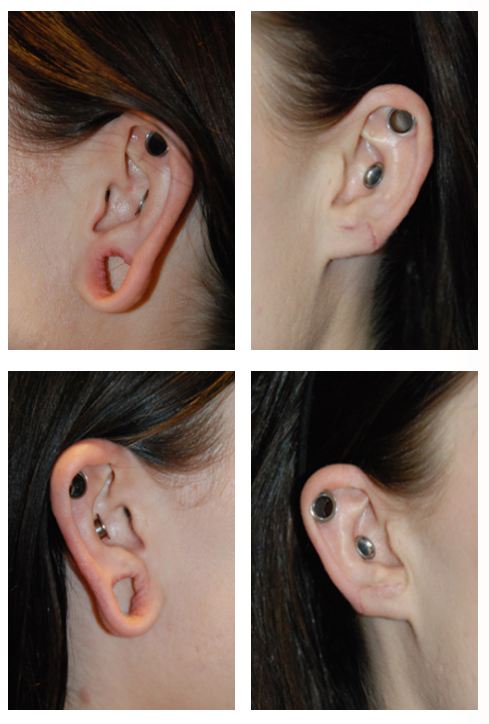
There are  a few ways to repair a torn earlobe (Dr Young is near Seattle, Washington).  A more complicated approach is to used intricate flaps to repair the tear and reconstruct a new ear ring hole.  But this reconstruction is tedious and has a tendency to for more scars and to leave a larger hole that you would like. My preference is to take out the tear and close the earlobe completely followed by a piercing done 2-6 months later when it is all healed.  The only drawback with earlobe repairs are the incision and the scar that it creates. What I do for the incision scar is to carry out a resurfacing during the time of the reconstruction so that when it heals the incision is harder to see.  What I do is after I excise the tear, I carry out some dermasanding to take the top layers of the skin around the incision.  I then close the incision.  In a few weeks to a month the incision is healed over and much harder to see.  The concurrent skin treatment allows the person to have it fixed plus an added scar revision in one sitting.

Thanks for reading, Dr Young

Dr Young specializes in Facial Cosmetic and Reconstructive Surgery and is located in Bellevue near Seattle, Washington

Is there a cheaper option for repairing the earlobe that are stretched out with gauges and is it possible to repair these for $400 for both ears which I’ve found over the internet.

Monday, January 25th, 2010

The price of 400 for ear lobe repair (otoplasty, ear reshaping, ear shaping, ear plastic surgery, ear cosmetic surgery) that you mentioned could be for one ear.  Also before knowing that is the price, when you actually go to the particular office they may mention that you need to pay a facility fee and anesthesia fee that could make that much more.  Be sure to ask about all the fees.  If it is true that the price they gave you is $400 for both ears and no other costs, I would check to see how well they do the procedure.  Sometimes, you get what you pay for.  Take a look at their results.  When you are talking about gauges, this could mean a significantly complicated repair that could require time.  For that price, if they take shortcuts, which often people do when they price things aggressively like that, you might not get what you wanted completely.

Thanks for reading, Dr Young

Dr Young specializes in Facial Cosmetic and Reconstructive Surgery and is located in Bellevue near Seattle, Washington

Earlobe reduction can markedly improve the aging looking earlobes.

Sunday, January 17th, 2010

Otoplasty (ear shaping, ear pinning, ear reshaping, ear plastic surgery, ear cosmetic surgery, earplasty) is the art and surgical procedure of shaping the ears to a desired shape. As one ages, your earlobe can lose volume and also ligaments within the earlobe can be stretched to ultmately give you a larger earlobe, with creases that can make your ears look aged.  Also, the enlarged earlobe can be distracting in and of itself from an aesthetic standpoint. Otoplasty can be done on the enlarged earlobe to acheive a shape and size that is more desirable in appearance.

Thanks for reading, Dr Young

Dr Young specializes in Facial Cosmetic and Reconstructive Surgery and is located in Bellevue near Seattle, Washington

Revising the earlobe due to a delay from a keloid in the area after an otoplasty procedure.

Tuesday, December 8th, 2009

Setting back the earlobe is not a difficult thing to do during otoplasty (ear shaping, ear pinning, ear reshaping, ear plastic surgery, ear cosmetic surgery, earplasty). You can cut the cartilage that holds the earlobe out (called cauda helicis). You can also adjust the skin to pull back the earlobes the right amount.  This can be done really anytime unless there are some things that were done near the area that might require healing before the earlobe revision.  The length of time to wait can be from 3 months more or less.

The biggest confounding issue is the Keloid.  The keloids can come back over and over again.  Steroids and excisions are the most common way to remove keloids. Sometimes, local flaps and recruitment of extra tissue and skin can be needed to remove keloids.  You should be prepared to have more than one revision to take care of the keloid.

Hope that helps!

Thanks for reading, Dr Young

Dr Young specializes in Facial Cosmetic and Reconstructive Surgery and is located in Bellevue near Seattle, Washington