Archive for the ‘Skin Care’ Category

Seattle Acne Scar Treatment Webpage Released

Monday, December 26th, 2011

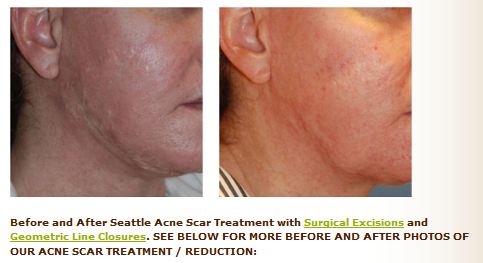
We have made a new webpage on Seattle Acne Scar Treatment  on our website www.drphilipyoung.com. We added some new pictures / photos and some links to help people understand a little more about how we are treating scars that were created by Acne. We would also like to explain a little about our thought process when it comes to treating Acne Scars.

Acne is a process that can affect all layers of the skin. The process originates from the hair follicle. The hair follicle depending on the point of the growth cycle that it is in will have a certain length that it goes in the skin. At times, the hair follicle will be very deep and sometimes less deep. The point is that when acne erupts, the process can extend deep into the skin and affect all the layers even the area deep to the skin. When scars form from Acne, they also affect all the layers of the skin. So the scarring is really pervasive. That makes treating acne difficult as well. When it comes to excisions, acne scarred skin is less pliable and it doesn’t stretch as much. This makes for a more difficult time with healing. Better results are harder to achieve. So you want to heal your skin. We believe that you have to prep the skin before you actually do other things like excisions, subcisions, punch grafting, flap reconstructions, and deep chemical peeling.  We have a 3-4 step process that we like to do for people. It entails 1. tissue grafting, 2. more invasive work such as excisions, subcisions, deep chemical peeling, punch grafting, flap reconstructions, 3. More refinement, 4. co2 laser resurfacing and dermasanding. Our goals are to heal the skin first, treat the skin with more invasive procedures to get the scarred skin to the same level, repeating the second step until the goals are reached, then refining our results with a polishing technique that entails co2 laser resurfacing and dermasanding.

You can go through our webpages with this in mind to better understand what we are aiming to do.

Thanks for reading

Our team at Aesthetic Facial Plastic Surgery!

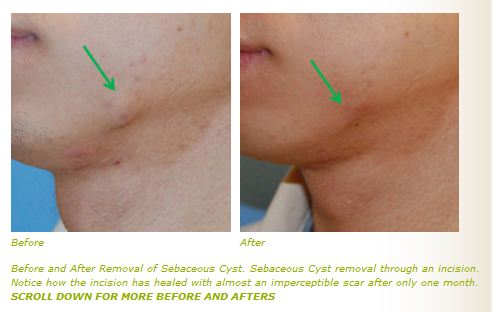
Epidermoid cyst removing them without a scar?

Friday, July 1st, 2011

This is my discussion on this topic:

The patient mentioned this: “I actually have an epidermoid cyst and dermatologists told me that there is no way to get rid of them without a scar. she said you can leave them alone and hopefullly one day they can go away.. is this the best advice with no scar ?”

I answered:”They could get worst and get infected.  If you don’t mind the cosmetic impact then you can wait and see what happens. I don’t usually see them go away and if they do it takes a long time”

Epidermoid cysts occur when there is some event that causes the hair follicle or pilosebaceous unit to become clogged and then the lining of the hair follicle starts to grow and form a cyst or pocket that goes into your tissues.  I am unaware of removing them without a scar. Usually the best way is to excise the lesion to get rid of them.  There are ways to make the incision look better.

Thanks for reading, Dr Young

Dr Young specializes in Plastic Surgery and is located in Bellevue near Seattle, Washington

How do I get rid of back hyperpigmentation?

Wednesday, January 12th, 2011

This a question that I answered for a patient who had fraxel resurfacing for acne on his back and subsequently had significant hyperpigmentation on his back. He wanted to figure out how to get rid of it. This is how I answered his question, in short:

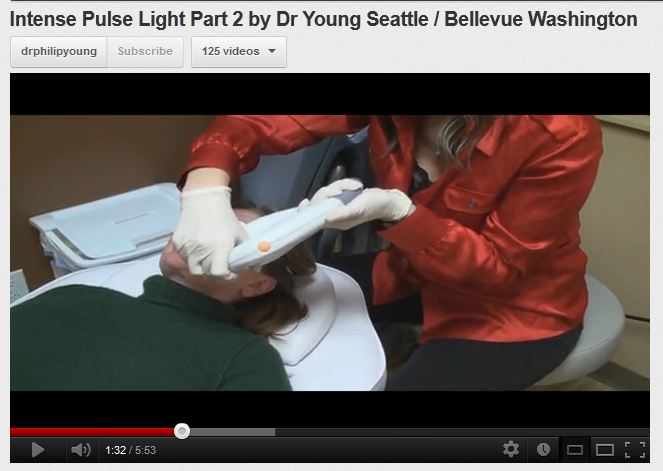
Intense Pulse Light, Medium depth chemical peels, fractional co2 resurfacing, skin care can improve back pigmentation. With Fraxel resurfacing the pigmentation could be at many different levels. More superficially, I would consider more aggressive skin care light lightening products (retinol, hydroquinone, hydrocortizone), 15% alpha and beta hydroxy lotion, at home glycolic peels.  Also for superficial pigmentation, lighter chemical peels 10-25% TCA (Tricholoroacetic Acid) peels, and active / deep fx could help.  For dermal pigmentation, active and deep fx could improve the pigmentation intense pulse light with varying filters could improve this, as well as different longer length lasers from 585-1064.  Dermal depths are deeper and not accessible to most superficial treatments.

Hope this was interesting

If you ever want some questions answered you can always email me here.

Thanks for reading, Dr Young

Dr Young specializes in Facial Plastic and Reconstructive Surgery and is located in Bellevue near Seattle, Washington
Cleaning your incisions after any procedure that requires suturing.

Friday, July 16th, 2010

This is a blog to discuss how to clean your incisions after any surgical procedure. The key for healing is to remove all crusting and to start with an incision that has the skin edges as close as possible together. The crusting is important to remove because the crusts can be nourishment for bacteria that can proliferate and cause more scarring. I usually suggest to my patients that they use vinegar and distilled water in a 1:3 dilution to clean the incisions. I tell people to do this twice a day. The goal is to get there incision to look like a fine wrinkle. If they keep doing this during the first 2 weeks the incision has the potential to heal incredibly. Always have vaseline over the incisions. It has been scientifically shown that skin cells grow faster when they have two surfaces to grow on. The vaseline serves as the other surface and this promotes the healing. You want the skin cells to grow over the incision as fast as possible. This reduces the scarring. Some people advocate hydrogen peroxide. I would caution that the use of this can be risky. I use the same dilution with hydrogen peroxide and distilled water in a 1:3 dilution. The key with the use of hydrogen peroxide if you are going to take the risk is to use it sparingly. You just want to use it to take the crusting off and then stop. If you do this more than that you can have more scarring. So being conservative is very important. If in doubt don’t use the hydrogen peroxide. And if you do use it, do so for only the first week and that is it. You should continue to clean your incision for about the first two weeks and keep vaseline on the incision at all times. After this you can do regular skin care and use sunscreen during the day (approximately 12 hours) and then silicone gel during the evening for 12 hours. The silicone gel can be found at any pharmacy or drugstore, like Bartells. I would do the silicone gel for the next 3 months. It is one of the only things that have statistically shown to make a difference in preventing scarring. Vitamin E, aloe vera, mederma based on my knowledge and recent literature search (05 / 2010) does not make a scientific difference. Following up with your doctor is really important to do so that they can make sure that you are on the way to healing the right way!

Thanks for reading, Dr Young

Dr Young specializes in Facial Plastic and Reconstructive Surgery and is located in Bellevue near Seattle, Washington
Can a diabetic get a microdermabrasion?

Friday, April 30th, 2010

Microdermabrasion should not lead to any issues in a diabetic.  You should be under good control however just to decrease any reaction or possible infection with the microdermabrasion.  Even if you sugars were not under total control the chance of something happening with superficial microdermabrasion is extremely small.  Microdermbrasion is a very superficial skin facial treatment and should not affect the skin’s water tight barrier to a great degree.  So introduction of foreign material, bacteria past the defences is much less likely with microdermabrasion as opposed to deeper chemical peels, laser resurfacing and dermabrasion.  Even with these deeper treatments, you can get them if you are a diabetic.  One thing to make sure is to have your sugars under control.  If this is not your current state, infections can be more risky for a diabetic with poor sugar control.

Thanks for reading, Dr Young

Dr Young specializes in Facial Plastic and Reconstructive Surgery and is located in Bellevue near Seattle, Washington
What are the options for Crows feet?

Saturday, March 6th, 2010

Crows feet are due to the eye muscles that surround the eye. These muscles are meant to close the eye, to blink, to protect the eye, etc.  When doing these movements, they can affect the skin around the sides of the eyes.  What results with this movement are the wrinkles that are commonly called the crowsfeet.  Botox is usually the way that people get some relief for them.  It usually takes about 8 – 12 units of botox on each side and the costs are around 10-16 dollars per unit of botox.  Other options include laser resurfacing, fillers, or fat injections for these wrinkles.

Fat injections and fillers function to do the same thing. When we age we lose volume in the skin and in the whole face in general.  What this does is bring the skin closer to the muscles of our face.  When we were young, there was a greater distance from the muscles of facial expression and the skin.  This distance was occupied by our skins fat and connective tissue.  When you smiled when you were young, the muscles tended to glide under your skin.  The fat in the skin above the muscles of facial expression allowed the skin to slide.  This exact phenomenon occurs in multiple areas of your body.  It is essential for muscle movement in fact.   As we age, the muscles of facial expression become closer to the skin, when we progressively lose the fat and connective tissue within and under the skin.  Hence, progressively when we smile are muscles of facial expression begin to exert more effects on the skin and these are manifested through wrinkling when we smile.  Through fat injections, fillers, or the YoungVolumizer, this layer of fat between the skin and muscles is increased and the muscles of facial expression have less of a wrinkling effect on the skin.

Resurfacing through chemical peels, lasers, or dermasanding / dermabrasion essentially takes away the top layers of the skin to allow skin cells deep within our hair follicles, glands etc to “resurface” the skin.  In the process of the procedure, we remove wrinkles, create a new layer of collagen underneath the skin, remove unwanted pigmenation and DNA damage, remove precancerous or cancerous cells, etc.  The skin then becomes renewed with healthier cells, you have less sun spots, wrinkles and the tone and texture of your skin is rejuvenated.

I hope that was interesting for you!

Thanks for reading, Dr Young

Dr Young specializes in Facial Cosmetic and Reconstructive Surgery and is located in Bellevue near Seattle, Washington

What is a glycolic peel best for treating?

Sunday, January 24th, 2010

Glycolic acid peels are superficial but can be important for regular skin care. They are superficial peels and the aggressiveness of the peel is dependent on the percentage of the glycolic acid in the preparation.  They are fairly safe and it is very difficult to make them deep and thus complications are much lower as compared to other peels.  One thing to remember is that sometimes the more aggressive you are the more results you will get for the most part.  Glycolic acid peels that are from 0-30% can be done at home with some guidance.  Anything stronger would be wise to be carry out with the guidance of a physician.  At home glycolic peels are a great way to keep up your skin from a maintanence stand point.  I usually start patients on a skin care program with retinols, hydroxy acids, buffing cleansers, gentle cleansers and see how they do and tolerate it.  Once this basic regimen is tolerated for a couple of weeks then I start them on the at home glycolic peels and guide them through this.  With this regimen, you can get your skin to turnover much quicker (from 28 days to 10-14 days or less).  This will help with unwanted pigmentation, decrease the size of pores, improve texture, and decrease fine wrinkles.

Thanks for reading, Dr Young

Dr Young specializes in Facial Cosmetic and Reconstructive Surgery and is located in Bellevue near Seattle, Washington

How often should you do chemical peels to maintain the results.

Sunday, January 24th, 2010

How often you do peels can be subjective and dependent on how you feel your skin is doing and for what condition you are treating.  Chemical peels can be varied in terms of how deep you want the peel and how deep the issues you are trying to treat. Superficial wrinkles and pigmentation issues can be improved by superficial peels.  Deeper wrinkles and pigmentation can be improved by more aggressive and deeper peels.  Deeper peels should not be repeated for several months and even up to a year.  Your physician can monitor how you are healing and determine this.  Superficial peels allow a faster recovery and thus you can do these much more frequently.  Glycolic peels can be done 2-3 times per week depending on how a person is tolerating the treatments.  Your doctor can help you determine this.  To maintain the results you need to determine with your doctor how your results are coming along.

Thanks for reading, Dr Young

Dr Young specializes in Facial Cosmetic and Reconstructive Surgery and is located in Bellevue near Seattle, Washington