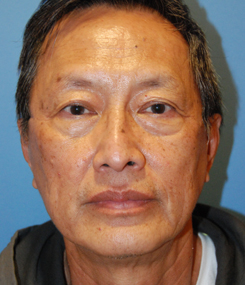
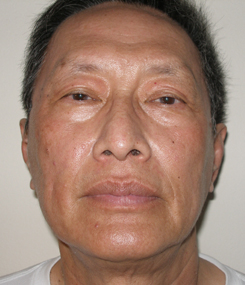
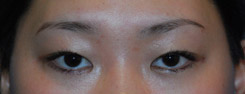
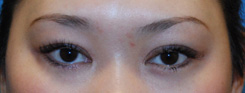
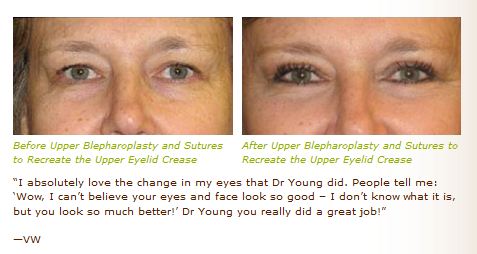
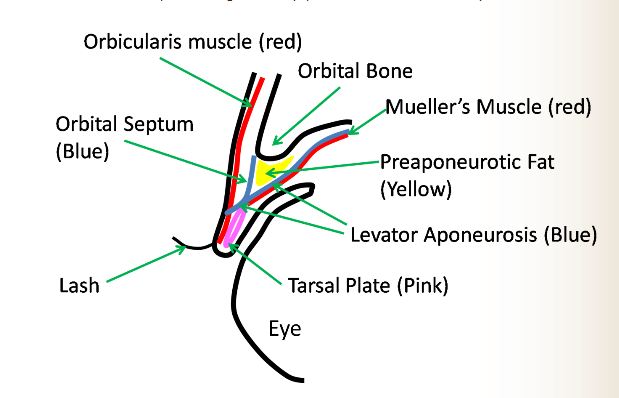
This is important to bring up for many reasons. This technique is quite different from the way 90% of surgeons do this procedure. We use this technique to create the crease and essentially permanent sutures are left in there to help keep your crease much longer lasting. Also the fold works more in a natural way. The technique is called the Orbicularis Fixation Technique for Asian Double Eyelids. The below anatomy will show you what we are talking about. Most surgeons perform the dermal fixation technique where the crease forming sutures are used to grasp the upper eyelid skin incisional edge then the levator muscle and then the lower eyelid incisional edge. These sutures are then taken out 6-7 days later. The crease is then dependent on scar formation to keep the crease. Sometimes this can be good enough, sometimes this can lead to asymmetric results and relaxation and multiple folds. The orbicularis fixation technique is based on the fact that the orbicularis muscle is tightly adherent to the skin of the eyelids. So attachment of this muscle to the levator is just like attaching the skin to the levator. Also with this attachment, the fold acts more natural. Meaning there is not a scar crease for the fold but it is created by the muscle attaching to where the fold should be. You can click here to learn more about Asian Eyelid Surgery.
Archive for the ‘Asian Cosmetic Surgery’ Category
Asian Eyelid Surgery: The Orbicularis Fixation Technique
Wednesday, September 5th, 2012Rhinoplasty evaluating before and after pictures
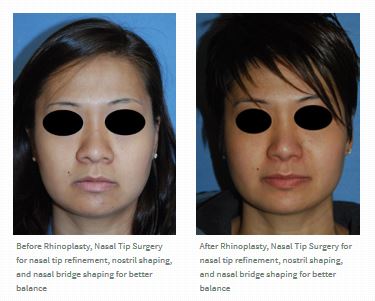
Friday, July 27th, 2012Before and after pictures are really important for you to see what you can expect from your rhinoplasty surgeon. A picture is worth a thousand words as they say. One thing you should really see is the before and afters from the profile view and even more importantly is seeing the results from the frontal view. The profile view is mainly a 2 dimensional view. It is much easier to get a good result on the profile view. This is why many surgeons choose to show only the profile view. If you see your surgeon only showing the profile view it would be prudent for you to see more photos from the frontal view, the view you see when you look directly at a person. Which is the view that matters the most. If you only see the profile view on their websites, this should be something to worry about. The frontal view is important for see how the nose looks from a 3 dimensional aspect. The frontal view is all about shadows and will tell you what the nose will really look like. IT is the hardest view to achieve the best results and the best before and after photos.
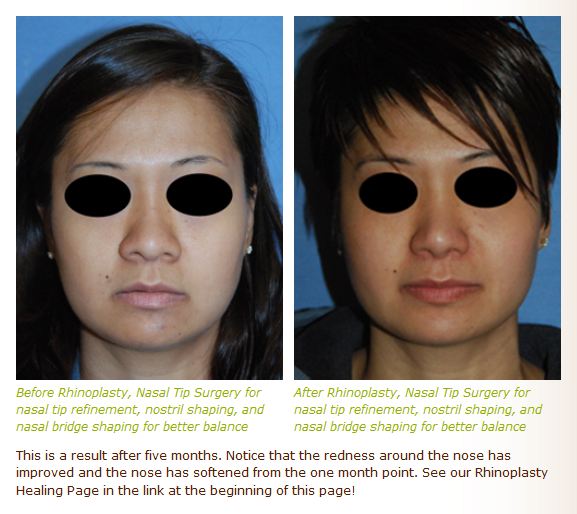
This is a frontal view of a patient that had a rhinoplasty to narrow the tip and the nostril area. Notice that she is now wearing shorter hair. You have to have confidence to wear short hair. She is really happy with her rhinoplasty results.
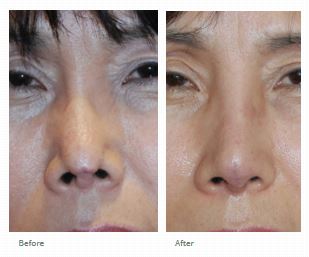
Here is a before and after a revision rhinoplasty for a person who had an implant extrude from her nose that was placed in Korea. She was super happy with her result! This patient is featured in our Asian cosmetic surgery page as well.
Thanks for reading and visiting our blog
Dr. Young from Aesthetic Facial Plastic Surgery.
Healing your body and mind
Friday, December 9th, 2011
Once you have the procedure you waited a long time for, it is time to be patient and wait, again, for your body to heal. Unfortunately, a surgeon’s scalpel is not a magic wand and healing will occur at different rates for different people. You must allow yourself to heal and be aware it is natural to be impatient for the results and a little anxious because you often look worse before you look better. Being aware this can happen will help you understand these normal feelings.
Sharing your experience with friends and family can help give you a support system during your recovery, but realize they may unintentionally make you question your decision with concerns during your recovery. While you may think that you are looking pretty rough around the edges, we may tell you that you are healing beautifully. Trust us. We will share with you if there is a concern, so if we tell you that everything is healing normally, it is.
Your healing will depend on many things such as your general health, your willingness to follow instructions, and your mental attitude toward recovery. While I can perform the surgery, I cannot “heal” you. It is up to you to be an active participant in your recovery process to help your body heal the best that it can. Following all of our instruction is very important, as is working with us to address any complications that may arise. Even surgeries that are done exactly right can have complications during recovery. It has to do with the human factor. We are not machines and every person can react differently and heal differently even when the surgery is done exactly the same. Every surgeon has unexpected results from time to time.
It is important you approach your surgery and especially your recovery with the mindset that we are a team, and you are an integral part of that team. We must trust each other to be working for a common goal, your successful result. As the surgeon, I enjoy my work and strive to achieve an ideal result during every surgery for every patient. I have rigorous standards that my staff must meet in order to be involved in your care. I am looking forward to working with you to achieve a great result and do not anticipate any post-operative problems. I will do everything I can to make sure that you are happy with your result.
I’m european and have low eyebrows and puffy eyelids. Would a brow lift be something for me?
Thursday, June 9th, 2011I see that you may have some fullness in the upper eyelid area. This is actually something that gives you youth and that is something to think about. Your eyebrows may be a little low but not worth the extent of a browlift. A browlift could feminize you and create more of a surprised look for you. I think if you were to consider something, I would suggest taking some skin from your upper eyelid or actually creating a crease as in Asian eyelid surgery. This could define your upper eyelids more. Your situation is something that Asian people inquire about all the time. A crease could decrease the puffiness you have to a controlled degree without lifting your eyebrows to a surprised and more feminine appearance.
Thanks for reading, Dr Young
Dr Young specializes in Facial Cosmetic and Reconstructive Surgery and is located in Bellevue near Seattle, Washington
My fold is too low after Asian Eyelid Surgery and would like it higher? CAn this be done? My previous surgeon said that there is not enough skin to do that.
Tuesday, June 7th, 2011Yes you can increase the height of the crease after Asian Eyelid Crease Surgery. It will entail setting the crease higher with a higher incision. The drawback in this situation is that you may have two incisions that could be exposed if you don’t have enough skin. It is likely that your crease is high enough and that all you need is more skin taken out. This is much simpler to do. The options are there for you. I think non incision techniques that the others are advocating is harder to achieve symmetry and long lasting results and you may need to get more surgery in the future to correct that approach. Below is a picture from our Asian Double Eyelid Procedure Webpage that discusses more details on this procedure.
Thanks for reading, Dr Young
Dr Young specializes in Facial Cosmetic and Reconstructive Surgery and is located in Bellevue near Seattle, Washington
Asian rhinoplasty for a hump and an area that could use an implant. How to make it harmonious with my forehead.
Tuesday, June 7th, 2011Asian rhinoplasty is a unique procedure all in itself within the realm of Asian Cosmetic Surgery. You have a bridge which is not as common as an Asian person that needs a bridge. You also need a bridge above the hump area. Ultimately, you should have this discussion with your doctor so he can tailor a procedure for you. What this is probably going to entail is reduction of the hump area and an addition of a graft above it. Alternatively, you could just need augmentation to camouflage the hump. There is a way to avoid making your nose bridge look weird after augmentation. There are standards for the Asian nose. typically the nose bridge starts below that of a Caucasian. Although I think that, in all races, there is an ideal to where the nasal bridge starts. A Caucasian nose normally starts at the eyelid crease or eyelid margin or somewhere between the two points. I have theory on beauty that has helped me decide exactly where the nasal bridge should start. I have a unique techinque with Asian Rhinoplasty that you can read about on my website.
Thanks for reading, Dr Young
Dr Young specializes in Facial Cosmetic and Reconstructive Surgery and is located in Bellevue near Seattle, Washington
Difference between Asian Rhinoplasty and Western Caucasian Rhinoplasty
Tuesday, June 7th, 2011Asian Rhinoplasty is different from rhinoplasty done for a Caucasian. Caucasians usually require reductive rhinoplasty. This entails making the nose smaller or “reducing’ the size of the nose. Asian rhinoplasty is typically an augmentation type of rhinoplasty where parts of the nose are actually made bigger like the tip and nasal bridge. The Asian rhinoplasty necessitates placing grafts from rib, ear, nasal septal and foreign material like silicone, medpor, and goretex. I have a unique approach to the Asian Nose that you can read about on my website. I have a video below and you can see more on my website.
Thanks for reading, Dr Young
Dr Young specializes in Facial Cosmetic and Reconstructive Surgery and is located in Bellevue near Seattle, Washington
Crusting 4 months after asian eyelid crease surgery. This is my 4th revision the first couple dropped?
Tuesday, June 7th, 2011Crusting after Asian Double Eyelid Surgery should not last more than 1-2 weeks. If the crusting lasts more than that, you may get scarring and difficult healing. I would have your facial plastic surgeon look at this situation as soon as possible. Otherwise, you might have a bad appearance from the scarring that could occur here. The dropping of the eyelid can occur more commonly with non-incision techniques. Also the skin to levator approach is dependent on scar tissue that can last and maintain the crease in a variable way. Meaning, the crease could last and persist differently in the eyes or asymmetrically in the eyes. This is due to the fact that these crease forming procedures are based on scarring to hold the crease. I carry out the Asian Eyelid Procedure in a unique way that lasts a long time. My procedure that I do is difficult, but once mastered makes a huge difference in terms of longevity. The procedure is uniquely called the orbicularis levator fixation technique. Below is the anatomy of the upper eyelid and will help you understand this technique once you follow the links to get to that page. This technique would be great for you because if you have a tendency to drop this technique actually leaves sutures inside your eyelid to hold your crease. These sutures stay in there permanently and this assures that the crease stays put and holds for the long run.
Thanks for reading, Dr Young
Dr Young specializes in Facial Cosmetic and Reconstructive Surgery and is located in Bellevue near Seattle, Washington
My eyelid crease is too high 3 days after Asian Double Eyelid Crease Surgery? What can I do?
Tuesday, June 7th, 2011Asian Eyelid Surgery: Early on the crease is much higher than will be the final result. The eyelid crease always looks much higher early on after Asian Double Eyelid Crease Formation. The swelling tends to take up the space of the skin that would normally fold over the crease. You don’t want to do anything at this early point in time. Your doctor will know best. The earliest that any Asian Eyelid Surgeon Specialist would do something would be at 2 weeks’ time. Don’t worry this will settle. You always have the option of making the crease lower if you desired or higher if you desired. There are many options.
Thanks for reading, Dr Young
Dr Young specializes in Facial Cosmetic and Reconstructive Surgery and is located in Bellevue near Seattle, Washington
Asian Eyelid Surgery through Incision or Partial Incision Techniques. Which is the better technique?
Sunday, June 5th, 2011Incisional Asian Eyelid Surgery is more accurate and longer lasting than partial and no incision approaches. The incisional approach allows the surgeon to see the structures that need to be adjusted to create the crease. This, in turn, allows the surgeon to directly work with these structures instead of doing it blind through partial and no incision techniques. The incisional technique also allows the surgeon to expose the structures that need to be cleared of tissue to allow the crease to be more definitely formed. Also with partial and no incision techniques, because of the blind approach, are more likely to have discontinuous creases, loss of the crease, and asymmetric results.
Thanks for reading, Dr Young
Dr Young specializes in Facial Cosmetic and Reconstructive Surgery and is located in Bellevue near Seattle, Washington