Archive for the ‘Scar Removal / scar reduction / scar revision / scar treatment’ Category

What can fraxel, ipl, chemical peels do to help Acne?

Friday, February 5th, 2010

What can fraxel, ipl, chemical peels do to help Acne?  The patient who asked this question also mentioned that another doctor told him that the scars eventually all reform and recreate the past scars.  What can be done for this patient.

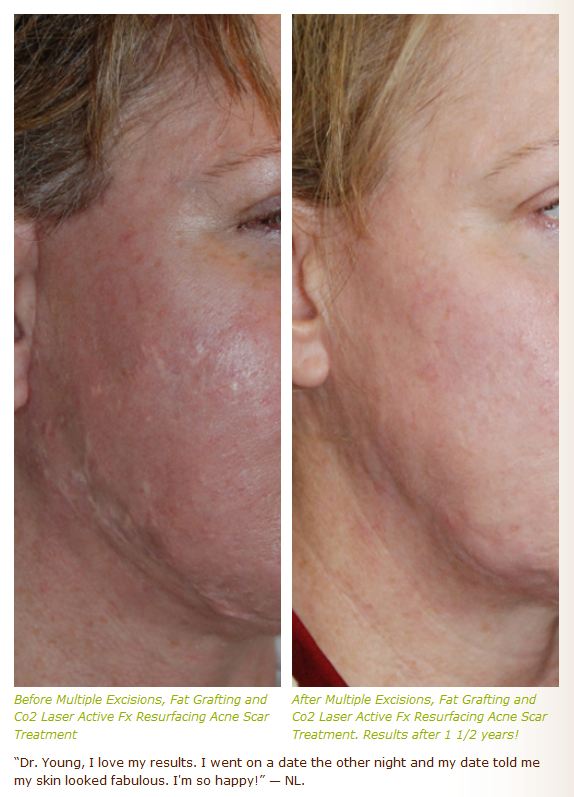
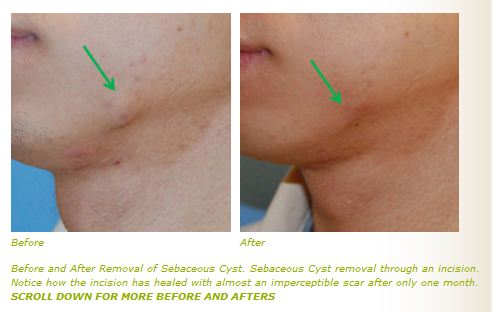
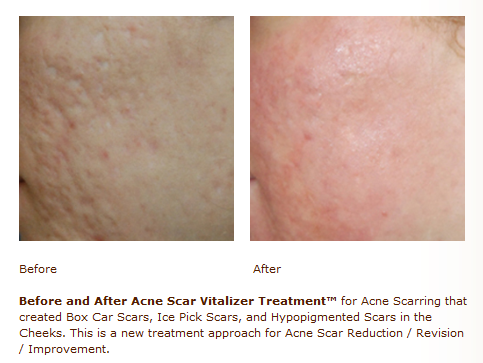
Acne scars (Dr Young Bellevue Washington) can be improved through excisions, resurfacing, fat injections.  It all depends on the type of scar you want to improve.  If there involves a significant difference in the level of the scar you need to improve that mostly by excision.  This is more so with depressed scars.  There are many ways to try to elevate the scars including very strong chemical peels in the depressed scars which will elevate the scars. Subcision is a technique that can be used to incise around the depressed scar releasing the tethering component to allow the scar to rise up to the level of the surrounding skin.  Or just excision which is the better choice because you make the ultimate incision smaller.  Resurfacing after the subcision or excision comes next and this is where the incisions are made to look less noticeable.  Sometimes through acne, scarring is extensive in the subdermal and subcutaneous plane causing large areas to be adhesed to the deeper tissue.  Filler can separate this scarring but the best thing for this is fat injections.  Injecting fat into this large layer of scar will soften the adhesions and allow the skin to become more free.  The extra volume also allows the skin to be taken up more reducing more lines and wrinkles and a coalescence of scars to make larger scars.  Also with the layer of fat, the skin can begin to heal and remodel itself to make the skin look better.

IPL can decrease any vascularity from the acne. Fraxel can shrink some parts of the scar. While chemical peels can remove some of the scars that are more superficial.  But my preference is to excise and then resurface with a co2 laser.  I also consider fat grafting underneath the skin to allow it to heal. I personally don’t think fraxel works well for Acne scars.  IPL can help with the vascularity of the scars if they are new or possibly any pigmentation issues of the scars but that is the most it will do.  Chemical peels can help like any resurfacing but can be limited without changing the depressed or raised nature of the scars.

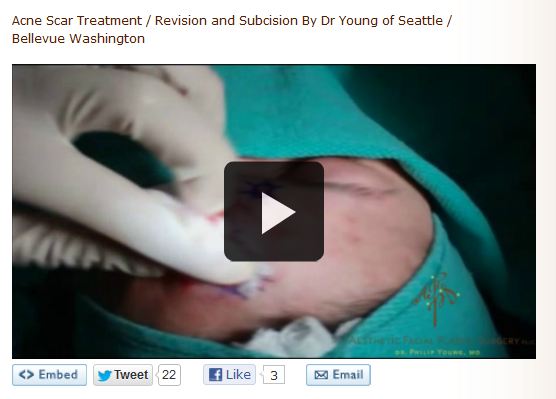
Here is a live demonstration video of an Acne Treatment Procedure.

Thanks for reading, Dr Young

Dr Young specializes in Facial Cosmetic and Reconstructive Surgery and is located in Bellevue near Seattle, Washington

Ice pick scars from a previous doctor who used a needle to treat my acne.

Monday, February 1st, 2010

This is a question that I answered for a patient who had another doctor treat his active acne.

The acne scars that you are talking about can occur from regular acne.  There are many people with ice pick type of scars.  The needle surgery that your doctor did would have helped more than hurt.  The expression of the pus from the acne that are infected would have caused much bigger scars if the needle didn’t express the pus away.  Now with your scars there are many ways to approach them.  One is through deep chemical peels that can be applied to the deep part of the those scars.  This can help to an extent.  What might even be better is to have them excised and then after that heals you can then have the areas resurfaced with lasers, like co2 lasers.  The excision then resurfacing route can lead to excellent results.  I also employ dermasanding to the deeper scars after doing a few passes to the lesions / scars when I do Acne Scar Treatment (Seattle).  You can search my website for some results and examples.

Here is a live demonstration video of an Acne Treatment Procedure.

Thanks for reading, Dr Young

Dr Young specializes in Facial Cosmetic and Reconstructive Surgery and is located in Bellevue near Seattle, Washington

How painful is dermabrasion? How would you rate the pain level? What are some anesthesia options for dermabrasion?

Monday, January 25th, 2010

Dermabrasion is a procedure where a wire brush is used to take down superficial and deeper layers of the skin to reduce scars, improve wrinkles, decrease pigmentary problems, etc.  It works under the same principle as Usually dermabrasion is not done without some type of anesthesia.  The types of anesthesia include local, regional, oral / iv sedation, general anesthesia.  Most physicians use a combination of above to do dermabrasion.  If it is a concentrated area like a scar, local anesthesia can be the only thing needed depending on the normal anxiety levels that a person usually gets in this type of situation.  If the person is likely to get anxious than oral or iv sedation can help.  For the whole face and larger areas, some type of whole body sedation through oral or iv sedation is helpful.  Regional anesthesia where the nerves are anesthetized can help the whole situation.

Thanks for reading, Dr Young

Dr Young specializes in Facial Cosmetic and Reconstructive Surgery and is located in Bellevue near Seattle, Washington

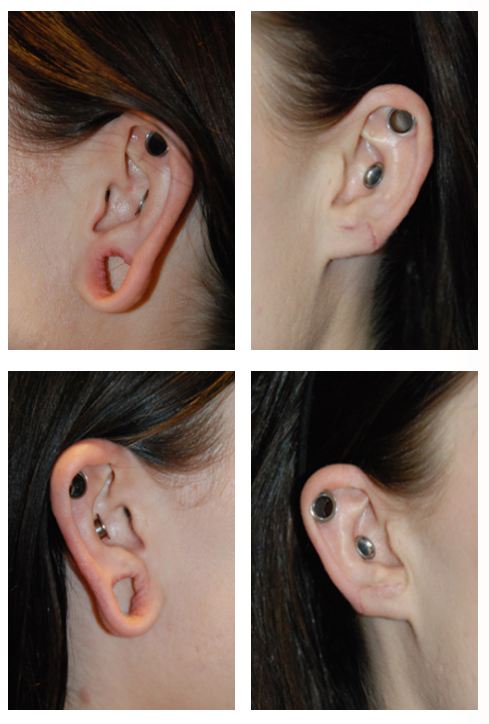
Revising the earlobe due to a delay from a keloid in the area after an otoplasty procedure.

Tuesday, December 8th, 2009

Setting back the earlobe is not a difficult thing to do during otoplasty (ear shaping, ear pinning, ear reshaping, ear plastic surgery, ear cosmetic surgery, earplasty). You can cut the cartilage that holds the earlobe out (called cauda helicis). You can also adjust the skin to pull back the earlobes the right amount.  This can be done really anytime unless there are some things that were done near the area that might require healing before the earlobe revision.  The length of time to wait can be from 3 months more or less.

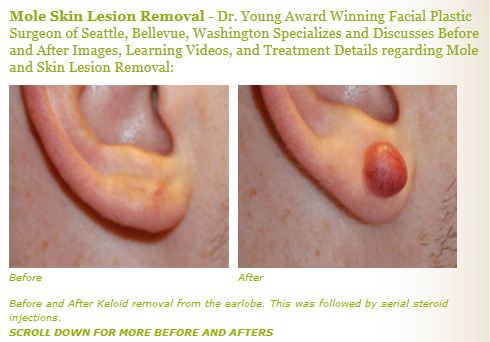
The biggest confounding issue is the Keloid.  The keloids can come back over and over again.  Steroids and excisions are the most common way to remove keloids. Sometimes, local flaps and recruitment of extra tissue and skin can be needed to remove keloids.  You should be prepared to have more than one revision to take care of the keloid.

Hope that helps!

Thanks for reading, Dr Young

Dr Young specializes in Facial Cosmetic and Reconstructive Surgery and is located in Bellevue near Seattle, Washington

Difference between co2 laser resurfacing with Lumenis and their active fx / deep fx / total fx / max fx technical advances explained

Monday, December 7th, 2009

active_deep_totalfx

skin anatomy

skin anatomy

A knowledge of skin anatomy can help with understanding resurfacing (laser peel, laser skin rejuvenation) of all types including laser, chemical, dermabrasion.  Taking a look at the cross sectional area of the skin, you can see that the skin is broken up into basically two areas, the epidermis and dermis. All resurfacing progressively take away layers of skin and by doing so remove skin lesions, unwanted pigmentation, wrinkles etc.  What happens is that the deeper skin cells located in the depth of the hair follicle eventually resurface and repopulate the skin.  during this process a layer of scar tissue and collagen is formed under the new basement membrane.  This new layer of collagen is thought to be responsible for some of the benefits of resurfacing including tightening of the skin and maintaining the decrease state of wrinkles.  The basement membrane is the connective tissue floor that the stem cells rest on where they reside and repopulate the more superficial layer of skin cells.  Active Fx essentially takes away more superficial layers confined to just above or just below the basement membrane depending on how many passes are done, what power and what density is chosen.  The basic principle of active fx is the use of a fraction of the spot size.  When you look at the picture above you can see that active fx has some wide dots, wider that the deep fx.  But the key are the areas in between the dots that represent untreated skin.  This untreated skin allows a faster recovery and less down time.  The goal is to get some of the effects of resurfacing without the downtime.  To help with the results of active fx, deep fx was added to create more tissue tightening to a deeper level.  Notice in the picture that with deep fx the dots are thinner.  Deep fx is thinner but it reaches to a deeper level heating up deeper layers and leading to more tissue tightening to a thicker amount of skin.  When deep fx is combined with active fx you can get better results than when each are used alone and this is done with less downtime than traditional resurfacing.  Total fx is when active fx is combined with deep fx.  Traditional resurfacing can be explained by active fx and that approach.  The difference is that the dots are much closer together and depending on whether you increase the density of the dots the dots may overlap to a varying degree.  When the dots start to overlap at a density of 4-5 you start to get into more traditional type of resurfacing where all parts of the skin are taken away or ablated per spot.  This approach does not leave healthy skin in between the treated dots, so the downtime is like older approaches. This use of active fx with dots touching or overlapping is more appropriately called max fx, or traditional co2 resurfacing. One thing to remember is that the more aggressive you are the more results but also the more risks are involved.  Total fx tries to get more results than you would normally get with a certain amount of risk. Here is a live demonstration of my use of a co2 laser and laser resurfacing.

Thanks for reading, Dr Young

Dr Young specializes in Facial Cosmetic and Reconstructive Surgery and is located in Bellevue near Seattle, Washington

Acne Scar Treatment Options

Monday, December 7th, 2009

There are many options for treating your scars from Acne (Acne scar treatment, acne scar reduction, acne scar removal, acne scar revision, scar revision).  A lot of the techniques used are based on what they look like.  Acne scars can be 1. elevated 2. depressed 3. come in different shapes 4. different colors 5. different locations 6. different sizes.  Elevated scars can be excised then followed up with excision 6-8 weeks after the excision. Depressed scars can also go through that same process.  In addition, you can carry subcision for depressed scars instead of completely cutting out the scars.  This entails cutting around the circumference of the scar and elevating it to the rest of the level of the skin. This usually requires suturing the newly elevated skin.  Linear scars that are longer than 7mm may need to be broken up into different directions or shapes to camouflage the straight line better. People tend to see lines that are greater than 7mm in length. Scars can be excised or resurfaced if they are different colors. Resurfacing entails taking away the top layers of the skin to allow deeper skin cells (that reside in the hair follicles that are a lot deeper) to resurface the layers of skin that were taken away by laser, chemical peels, or dermabrasion.  Depending on the location, there are different issues to think of in order to allow the scar to heal in the best possible way.  Depending on the size, other techniques could be considered. Recruitment of tissue is sometimes necessary to get the best possible result.  Local tissue that is next to the scar can be used. Regional tissue that can be rotated in based on definitive blood flow and  sources.  Free tissue that is totally removed from the source and reimplanted into the scarred area by connecting blood vessels is needed on the more extreme end of cases.  Here is a live demonstration video of an Acne Treatment Procedure.

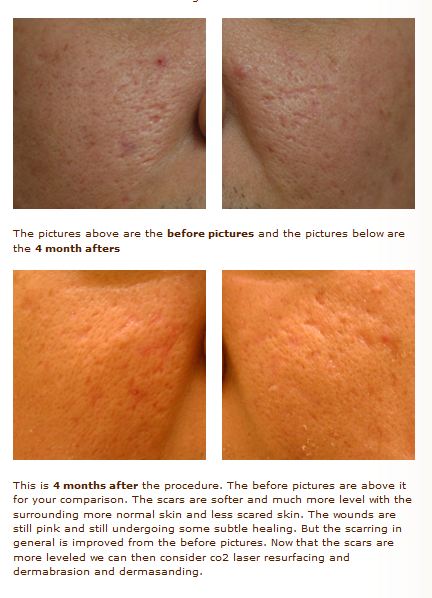
An example here shows elevated scars that were excised at the first stage, closed in different patterns for camouflage, and then resurfaced with a co2 laser(total/max/active/deep fx).

Thanks for reading, Dr Young

Dr Young specializes in Facial Cosmetic and Reconstructive Surgery and is located in Bellevue near Seattle, Washington

Before Acne Scar Treatment

Before Acne Scar Treatment

After Acne Scar Excision / Camouflage Techniques

After Acne Scar Excision / Camouflage Techniques

After Acne Scar co2 Laser Treatment

After Acne Scar co2 Laser Treatment

What results can I expect from scar revision surgery after worsening scars around my ear and face?

Monday, December 7th, 2009

It always depends on what your scars look like.  Options for scar revision (scar treatment / scar improvement / scar reduction, scar removal) include:

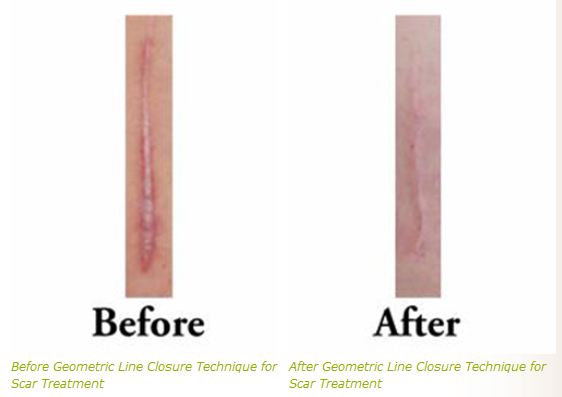
1. excision and reexcision: straight closure, running w plasty, multiple z plasties, geometric closure.

2. skin resurfacing: including laser, dermabrasion, chemical peels

3. tissue expanders to recruit more skin

4. local flap surgery whereby skin and tissue are recruited to reline the areas of scars

5. free flap surgery where tissue from some other part of the body is transferred to the areas of the scars and connected with blood vessels.

Many scars are excised and reclosed.  There are many options with this approach.  You can cut the scars out and close them as a straight line.  Your eye however usually notices anything that is longer than 7mm.  So many times, it helps to close the new incision not in a straight line but broken up into “w’s”, “z’s”, or multiple patterns (geometric line closures).  This is done in attempts to trick the mind by not having any line longer than 7mm.

Resurfacing is always an option to improve the scar by taking the scars away on the surface and allowing new skin to grow over to improve the appearance.  This can be done with lasers, dermabrasion, chemical peels, and dermasanding.

If there is a big area to improve, sometimes having more normal looking tissue is needed. This is where the concern with bringing in tissue comes into play. Tissue expanders allow you to make more skin. You have to go through expansion of your skin with a balloon under the skin near the area you are wanting to correct.  Expansion occurs every 2-3 weeks.  Once you have enough tissue you can then take the expander out and then the new tissue is used to reline the scarred area.  Local flaps can be rotated into the area.  If this is not enough, you can then take skin and tissue from another area and hook up the vessels to reline the scarred area.

The other option includes fillers that are an adjunctive option.  Fillers essentially fill in the volume deficiency that sometimes is present in the scarred area.  Fat injections, which are a filler that uses your own fat can fill in volume and also regenerate your skin through incorporation of new stem cells in the fat.  These stem cells can have a regenerative property on scar improvement.

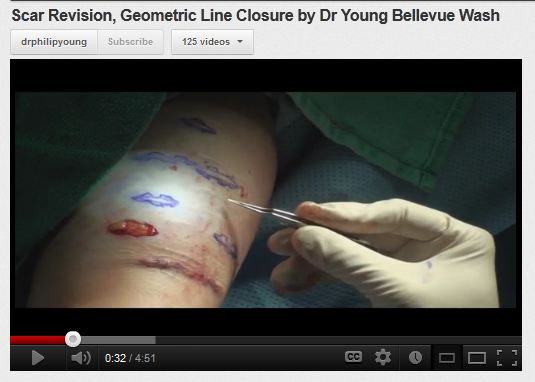
From a results standpoint, you shouldn’t expect it to make your scar back to complete normal.  This is impossible.  But through scar revision the scars can be really improved.  That is the key to scar revision the word “improve”.  Here is a video on Scar Revision.

Thanks for reading

Dr Young

Dr Young specializes in Facial Cosmetic and Reconstructive Surgery and is located in Bellevue near Seattle, Washington

Scarring and whether Photofacials / Intense Pulse Light can help the appearance.

Thursday, September 3rd, 2009

More and more research is showing that scar production has a large contribution from the inflammatory component and that blood flow is a perpetuator.  Intense pulse light and photofacials (or laser scar revision)can be used to target the blood flow to the scar and hence stiffle the blood flow that is feeding the scar production.  Ultimately, this leads to less scarring and a better appearance to the scar.  Timing is important, your scar should be in the inflammatory stage where blood flow plays an important part.  If the scar is mature, the results will be less impactful.  It really depends on how your scar looks.  You may need a formal scar revision (or scar treatment / scar removal / cosmetic scar surgery / scar plastic surgery) with excision and a reclosure of the wound to improve it.

Thanks for reading, Dr Y

Dr Young specializes in Facial Cosmetic and Reconstructive Surgery and is located in Bellevue near Seattle, Washington

Keloids and how to treat them

Thursday, September 3rd, 2009

Keloids are a hard thing to improve through scar revisional techniques.(scar removal / scar treatment / scar revision) Invariably they always come back to some extent.  Steroid injections are helpful after excising them.  During my fellowship training in Louisiana, I had a lot of experience with Keloids / large scars / hypertrophic scars.  One thing we did there is take them out and let them heal secondarily or open without closing them and creating additional tension.  That seemed to help that population a lot of times. This is something you should ask your doctor about.  There is scientific basis to how that helps the healing.  I did some extensive research on this.

Thanks for reading, Dr Y

Dr Young specializes in Facial Cosmetic and Reconstructive Surgery and is located in Bellevue near Seattle, Washington

Approach to small pox scars through excision, resurfacing and hair transplantation?

Wednesday, July 8th, 2009

Small pox scars are a lot like Acne Scars. The pox scars can appear very differently in people.  Depressed scars can be excised or they can be elevated and then resurfacing can then be done.  Excision of the scars will likely need two stages.  You would need to excise them at the first stage and then allow them to heal. At 6-8 weeks or later, we can then do the resurfacing procedure to smooth over the incision from the excision.  If you want to do it in one stage, you can elevate the scars through punch excisional techniques where the depressed scar is incised completely around it and then elevated so that the skin is at the same level.  Once this is done with all of the depressed scars you can then resurface the face or area at the same time.  Results can be as good as the two stage approach.  When the scars are raised, you can use resurfacing techniques to lower the raised portion and then the area can be healed over by the migrating cells.  Hair transplantation can help but they can be placed in areas that you might not want hair located at.  You have to make sure you don’t mind hair in the area that you transplant hair.  With the above techniques you may not need hair transplantation given the excellent results that you can attain. Here is a live demonstration of my use of a co2 laser and laser resurfacing.

Dr Young is located in Bellevue near Seattle, Washington